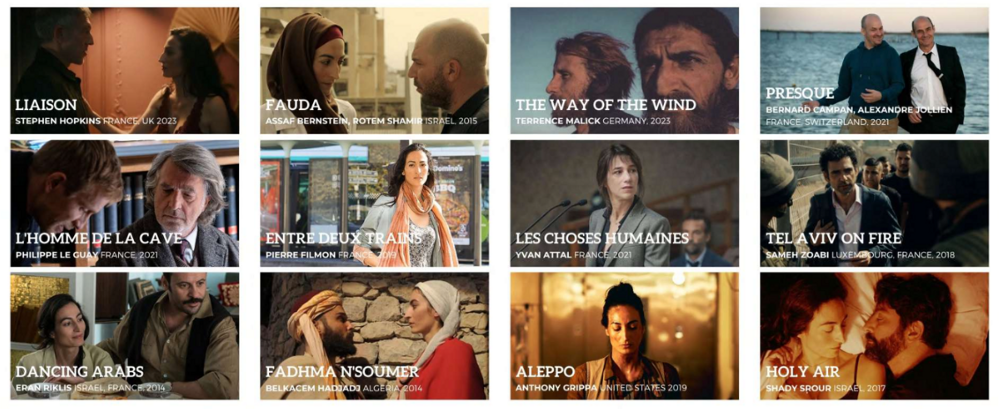
French actress Laëtitia Eïdo, internationally acclaimed for her heart-wrenching performance as Dr. Shirin in the globally successful Netflix series Fauda, moves between art-house films, action-packed series, and major studio productions, while also remaining a regular presence on the theater circuit. She has delivered award-winning performances in several languages, including five Best Actress awards. She's also the voice of Mira in the animated series Primal, which has won 5 Emmy Awards.
She has been described as "a young Meryl Streep" for her versatility and tendency to "steal all her scenes" (Jerusalem Post), and referred to by critics as a "standout actress," "the beating heart of the Fauda series," "sensual," and "fiercely funny" (Deadline). Laëtitia was classically trained in Paris and New York, from Peter Brook's to Jacques Lecoq's theater companies. She then immersed herself in the Meisner technique, which completely transformed her approach to acting. Laëtitia remarked, "Acting for me is constantly delving into the mysteries of the human soul and finding the purest way to convey emotions as a healing channel for the audience."
She will return to the small screen worldwide with Blood Coast (aka Pax Massilia) by Olivier Marchal on Netflix as the commanding antagonist, and will also star in La Terre et le Sang by Ange Basterga for France 2, and La Cible by Ivan Fégivères.
She recently starred alongside Aaron Eckhart in the spy thriller Chief of Station, and alongside Vincent Cassel and Eva Green in the Apple TV+ French- and English-language series Liaison. She starred once again with Eva Green in Martin Campbell's (Casino Royale, GoldenEye) feature Dirty Angels, and in the independent Belgian film The Virgin and Child, as well as in the French action film Elyas (Canal+), directed by Florent-Emilio Siri, sharing the screen with French César Award-winning actor Roschdy Zem. She also features in the French series Culte by Louis Farge and is expected to appear in Terrence Malick's highly anticipated The Way of the Wind.
Laëtitia Eïdo has developed her artistry across a range of different mediums. A graduate in architecture, one of her works was exhibited at the Eiffel Tower as part of an international professional design competition. She went on to earn a Master's degree in Scenography and Playwriting from the Sorbonne-Nouvelle, and published her theatrical research in the prestigious Registres magazine (2005). She has designed the sets and posters for several theatrical productions, including B.M. Koltès's Roberto Zucco and Shakespeare's Romeo and Juliet for the Théâtre Montansier in Versailles. She has also worked on film sets as First Assistant Set Designer, and later as First Assistant Director. Today, she continues her artistic journey through photography, graphic arts, and writing across several projects: a six-track musical EP; her own one-woman show; and several projects she aims to direct. She recently presented her paintings in an exhibition at Les Arcenaulx in Marseille.
She has been described as "a young Meryl Streep" for her versatility and tendency to "steal all her scenes" (Jerusalem Post), and referred to by critics as a "standout actress," "the beating heart of the Fauda series," "sensual," and "fiercely funny" (Deadline). Laëtitia was classically trained in Paris and New York, from Peter Brook's to Jacques Lecoq's theater companies. She then immersed herself in the Meisner technique, which completely transformed her approach to acting. Laëtitia remarked, "Acting for me is constantly delving into the mysteries of the human soul and finding the purest way to convey emotions as a healing channel for the audience."
She will return to the small screen worldwide with Blood Coast (aka Pax Massilia) by Olivier Marchal on Netflix as the commanding antagonist, and will also star in La Terre et le Sang by Ange Basterga for France 2, and La Cible by Ivan Fégivères.
She recently starred alongside Aaron Eckhart in the spy thriller Chief of Station, and alongside Vincent Cassel and Eva Green in the Apple TV+ French- and English-language series Liaison. She starred once again with Eva Green in Martin Campbell's (Casino Royale, GoldenEye) feature Dirty Angels, and in the independent Belgian film The Virgin and Child, as well as in the French action film Elyas (Canal+), directed by Florent-Emilio Siri, sharing the screen with French César Award-winning actor Roschdy Zem. She also features in the French series Culte by Louis Farge and is expected to appear in Terrence Malick's highly anticipated The Way of the Wind.
Laëtitia Eïdo has developed her artistry across a range of different mediums. A graduate in architecture, one of her works was exhibited at the Eiffel Tower as part of an international professional design competition. She went on to earn a Master's degree in Scenography and Playwriting from the Sorbonne-Nouvelle, and published her theatrical research in the prestigious Registres magazine (2005). She has designed the sets and posters for several theatrical productions, including B.M. Koltès's Roberto Zucco and Shakespeare's Romeo and Juliet for the Théâtre Montansier in Versailles. She has also worked on film sets as First Assistant Set Designer, and later as First Assistant Director. Today, she continues her artistic journey through photography, graphic arts, and writing across several projects: a six-track musical EP; her own one-woman show; and several projects she aims to direct. She recently presented her paintings in an exhibition at Les Arcenaulx in Marseille.
… more infos
Laëtitia Eïdo's career on screen started in France with the role of Cleopatra in ‘The destiny of Rome’ (ARTE) ; she was then an Indian super-hero in the successful Tv-Series ‘Hero Corp’ by S.Astier. But Laëtitia made her debuts on stage, with various significant parts including ‘Andromaque’, in Racine's Greek tragedy ; or Eglé in Marivaux's French classic ‘The Dispute’. She has been back on stage in 2017 with the theatrical adaptation of ‘The 4th wall’, a novel by Sorj Chalandon (GONCOURT Lycéens 2013) directed by A.Stéphan, at the Brittany National Theatre (TNB - Rennes). Then in 2019 with ‘Metamorphosis’ (Ovidius) dir. by L.Giacomoni at La Tempête theatre (Cartoucherie de Vincennes).
She was a ‘Talent’ Alumna at Berlin Film Festival (2015) and a Jury Member in prestigious festivals like Jerusalem, Oran, ‘Cannes Series’ (2020) and for the ‘Queer Palm’ award at Cannes Film Festival (2017).
She was a ‘Talent’ Alumna at Berlin Film Festival (2015) and a Jury Member in prestigious festivals like Jerusalem, Oran, ‘Cannes Series’ (2020) and for the ‘Queer Palm’ award at Cannes Film Festival (2017).
"Discovering the MEISNER method, taught by Scott Williams - who was one of his students - completely changed my relationship to my craft as an actress. This approach to acting was THE answer to all the questions that other acting methods left me feeling deeply frustrated about. I discovered the immediacy of acting in the present moment. The strength that comes from truly diving into the Other's eyes. The incredible energy that instantly radiates from our bodies - and our hearts - the moment we allow ourselves to stop being "polite" (while still always respecting the other person's boundaries) and we listen, and above all finally follow our instincts, our "impulses"... that's when anything can happen. The set then becomes a "ring" of emotions, where we, as "athletes of feeling," can use our tools and let whatever comes arise, let ourselves be surprised, in total freedom... That's how we become artists fully engaged in creation, rather than simply puppets to be directed. Our creative range becomes limitless, and we don't even know its full extent ourselves: that's where the rediscovered joy of "play" lies, along with the adrenaline rushes that come with it when we rediscover everything (the text, the scene, the scene partner) in every single moment. But for that, like a dancer, you have to train, not let our emotional muscles "rust," and again and again get back to work, experiment, explore our inner territories, keep working..."
Laëtitia
Laëtitia